University Fee Calculation Scenario
Universities often have a tiered fee structure based on various parameters such as the student's major, year of study, residential status, and extra-curricular activities. Additionally, scholarships or financial aid might further adjust these fees. This tutorial aims to detail the fee calculation process for a fictional university, helping automate fee determination and ensuring accuracy and fairness.
What We Will Do:
Gathering Student's Information
Capture essential student details:
- Full Name
- Major/Department (e.g., Engineering, Arts, Business)
- Year of Study (e.g., Freshman, Sophomore, Junior, Senior)
- Residential Status (e.g., In-State, Out-of-State, International)
- Scholarships/Aid (e.g., Academic Merit, Sports Scholarship)
Base Tuition Fee Calculation:
- Data Gathering:
- Major/Department influences the base tuition fee.
- Year of Study can sometimes influence the tuition fee.
Calculation Process
| Major | Base Tuition (per semester) |
|---|---|
| Engineering | $10,000 |
| Arts & Science | $7,000 |
| Business | $8,500 |
Residential Fee Adjustment
- Data Gathering:
- Residential Status affects the final tuition fee.
Adjustment Process:
| Residential Status | Adjustment Fee |
|---|---|
| In-State | No Adjustment |
| Out-of-State | + $2,000 |
| International | + $3,500 |
Scholarships and Financial Aid Deductions
- Data Gathering:
- Type of Scholarship/Aid and its value.
Deduction Process:
| Scholarship/Aid Type | Deduction |
|---|---|
| Academic Merit | -$2,000 |
| Sports Scholarship | -$1,500 |
Note: A Student can take one Scholarship per semester and its deducted after the residential adjustment.
Communicating Final Tuition Fee: Building the Flow
After all calculations, the final fee payable for the semester will be provided to the student, ensuring transparency. A detailed breakdown will showcase how various components affected the tuition fee, providing clarity to the student.
Solution
Step 1: Creating a Validation Set to validate the student university details.
To initiate our solution, we will be designing a Validation Set. That accept student informations as input.
- Full Name
- Major/Department
- Year of Study
- Residential Status
- Scholarships/Aid
Each of these inputs is equipped with its own validation block to ensure accuracy and correct format, as shown in the picture below.
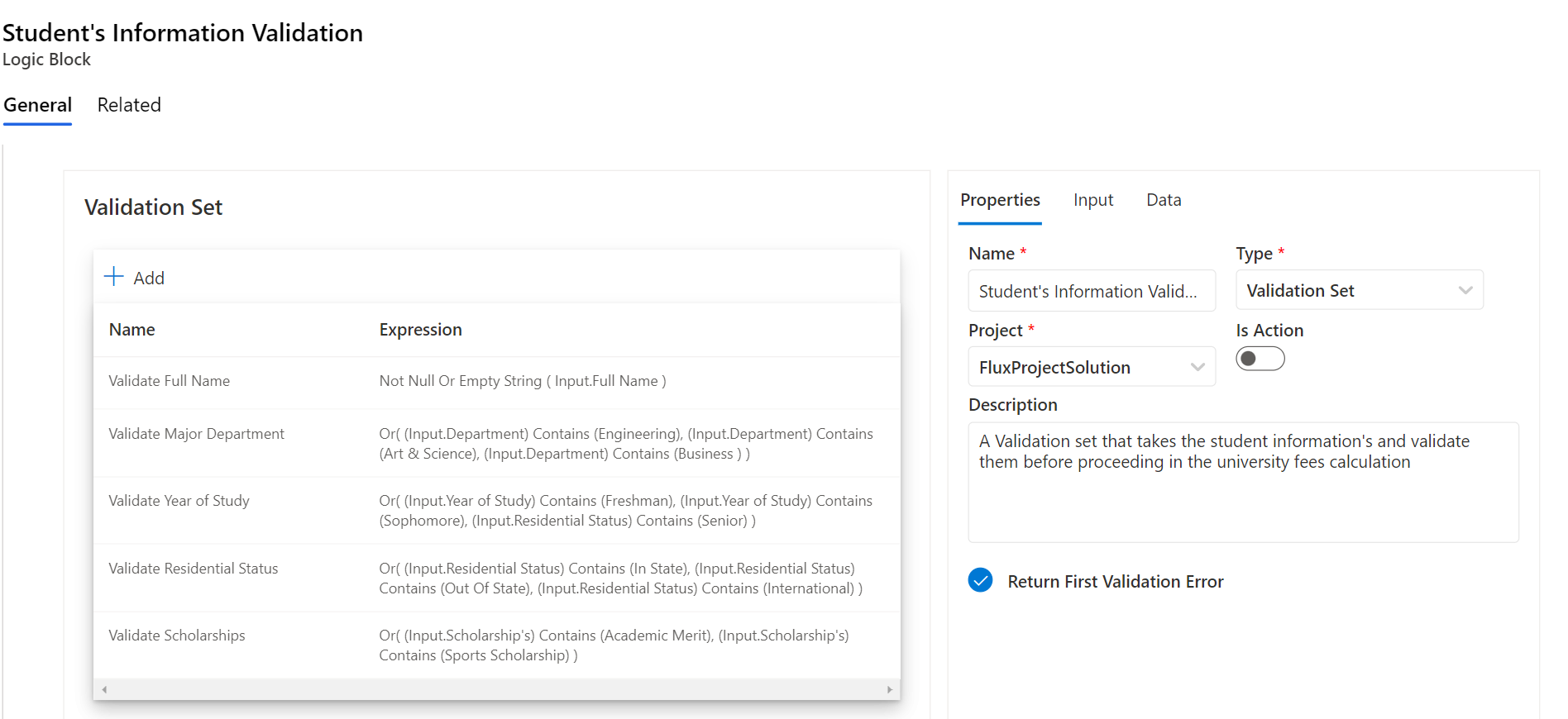
And the validation set return an error upon encountering the first inconsistency or inaccuracy. This is to ensure immediate feedback for rectification. With our Validation Set in place, it guarantees that all subsequent steps in the evaluation rely on verified and dependable data.
Step 2: Creating a Decision Table to set the base tuition fee.
As we progress in the process of determining the final tuition fee for a student, the second critical step involves setting a foundational value based on their major. To accomplish this, we've designed a decision table, which provides the base tuition fee for each major.
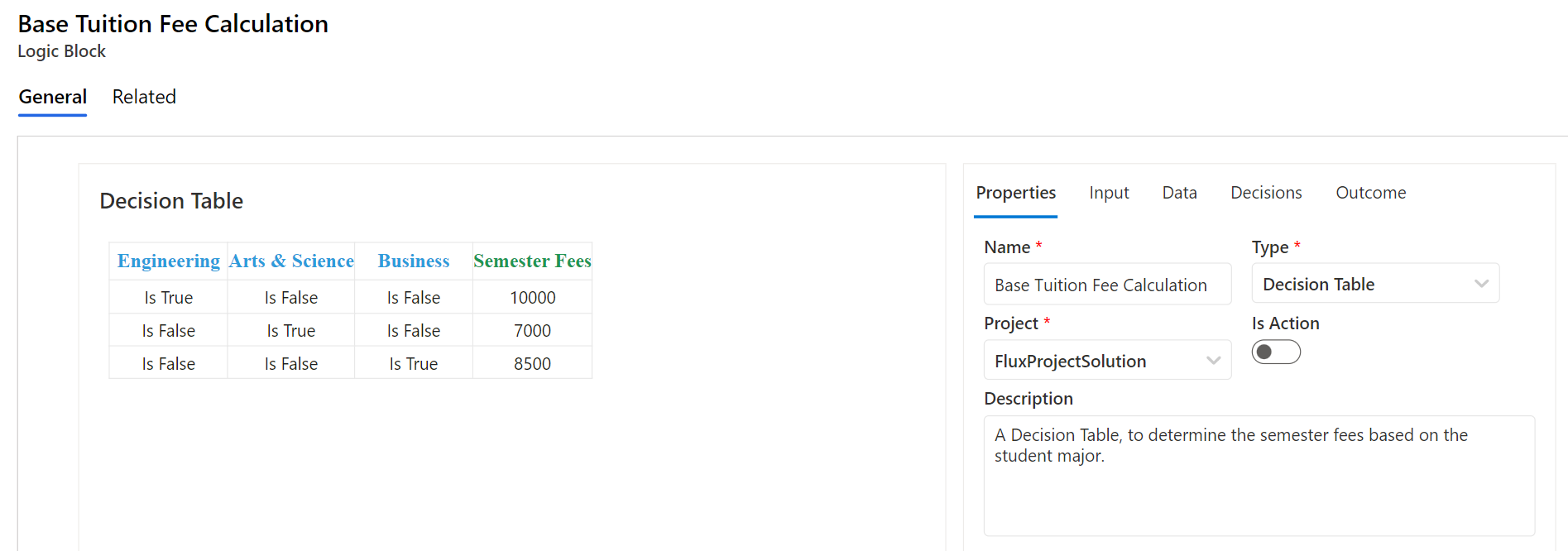
In the table above, in the first row, we observe that only the Engineering column holds a true value, signifying that the base tuition fee for an Engineering major is $10,000 per semester. Similarly, in the second row, only the Arts & Science column is true, setting the base fee for those majors at $7,000. In the third row, it's the Business column that's true, which corresponds to a base tuition of $8,500. With this decision table in place, we can easily refer to and apply the appropriate base tuition rate based on a student's chosen major.
Step 3: Creating a Decision Table to determine the adjustment fees based on the residental status
Moving forward to the third step in our tuition fee determination process, it's essential to consider the influence of residential status. Residential status often has a substantial impact on the tuition fee structure at many institutions. For this purpose, we've laid out a decision table which vividly illustrates the adjustments made based on a student's residential classification.
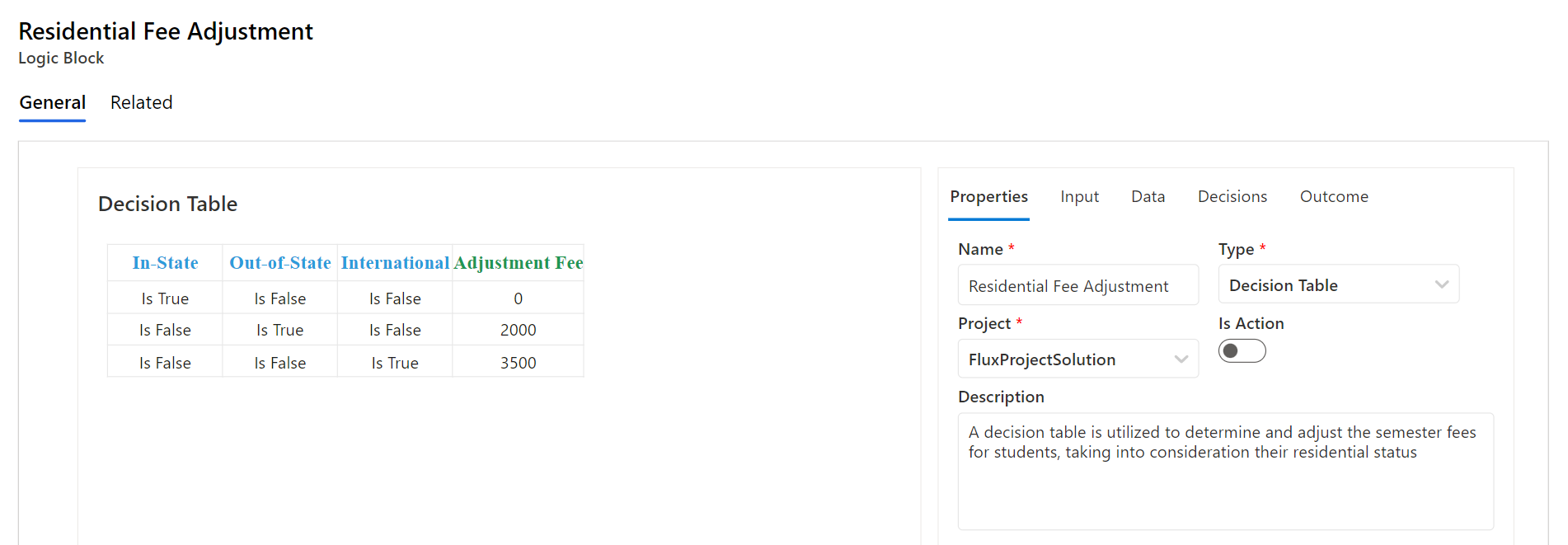
In the table above, in the first row, we note that only the 'In-State' column is indicated as true. This implies that for students with an 'In-State' residential status, there's no additional adjustment to their tuition fee. Moving to the second row, only the 'Out-of-State' column is true, suggesting an added fee of $2,000. Finally, in the third row, where the 'International' column stands true, an increased fee adjustment of $3,500 is applicable
Step 4: Creating a Decision Table to determine the scholarship value
As we delve deeper into our tuition fee determination process, the fourth pivotal step is to account for any scholarships or financial aids that a student may have been awarded. Scholarships often significantly reduce the financial burden on students and need to be accurately reflected in the final fee. To aid this, we have a decision table that elucidates the deductions associated with each scholarship type.
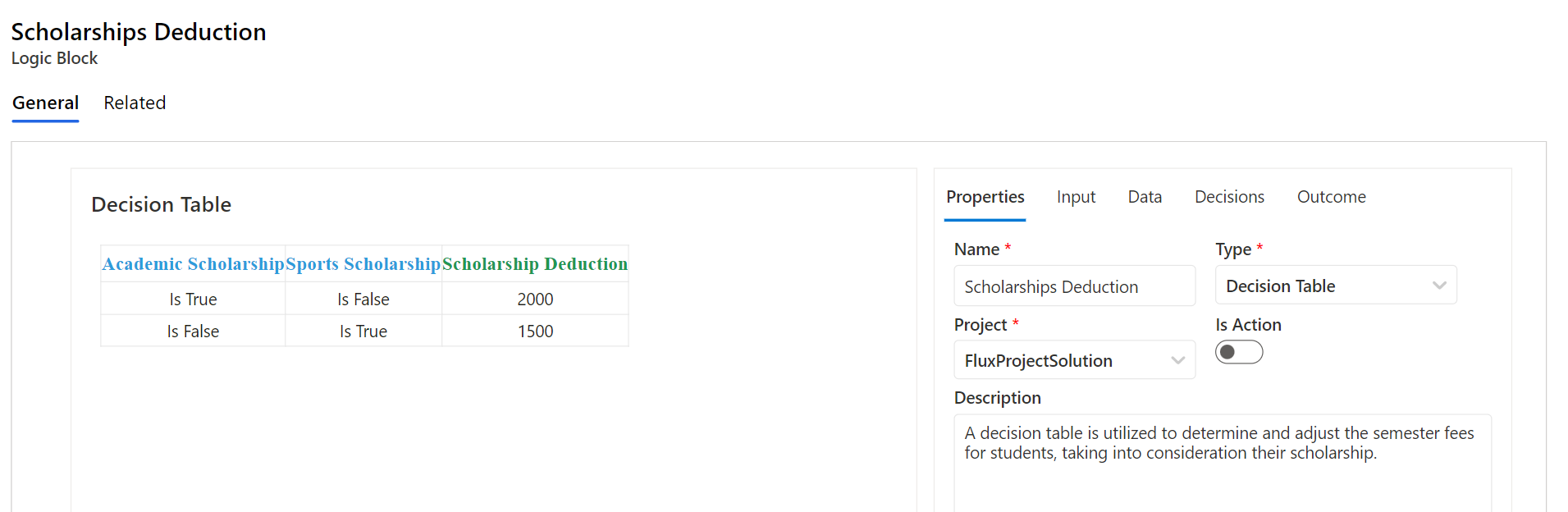
From the table above, in the first row, we observe that only the 'Academic Merit' column is indicated as true, leading to a deduction of $2,000 from the tuition fee for students who have been granted this scholarship. In the subsequent row, where the 'Sports Scholarship' column stands true, there's a corresponding deduction of $1,500 for those who have been awarded this particular scholarship.
Step 5: Creating a Formula to calculate the final tuition fee
Having established the different parameters in our previous steps, the culmination of our process lies in Step 5. This is where we integrate all the components we've discussed – the base fees, residential status adjustments, and scholarship deductions – into one comprehensive formula. This formula will facilitate the calculation of the final tuition fee for each student with precision.
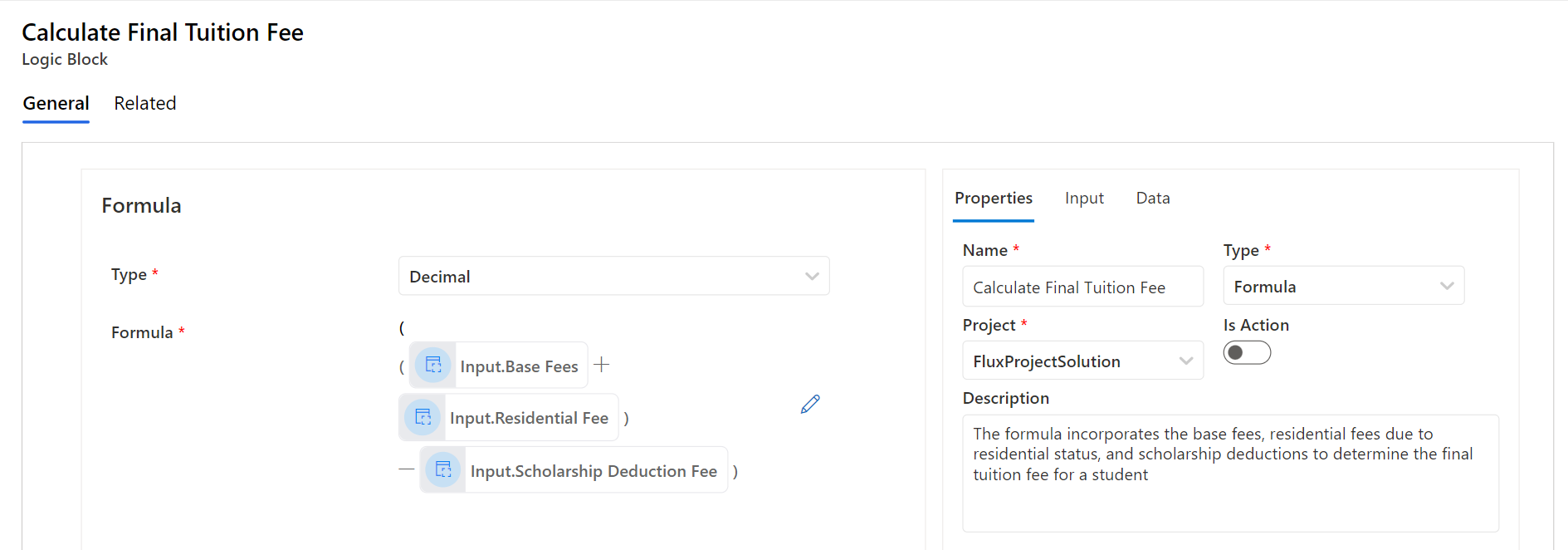
Using the above formula, we begin with the 'BaseFees', a reflection of the student's chosen major. We then factor in the 'AdjustmentFee' based on residential status and finally deduct any scholarship or financial aid amounts represented by 'Deduction', ensuring students benefit from their earned financial incentives."
Step 6: Connecting the Dots - Building The University Fee CalculationS Logic Flow
Flows logic function as structured sequences, emphasizing the systematic orchestration of tasks in a designated order. At the heart of these flows lie the logic blocks, meticulously crafted to facilitate the decision-making processes inherent in complex systems. In the context of determining the university tuition fee for a student, the logic blocks are designed to ensure every single detail, from major to residential status to scholarships, is accounted for. Each logic block is positioned within the flow to maximize efficiency and accuracy. If any discrepancies arise during the validation stages, an error is raised, ensuring timely correction and the ultimate accuracy of the final fee calculation.
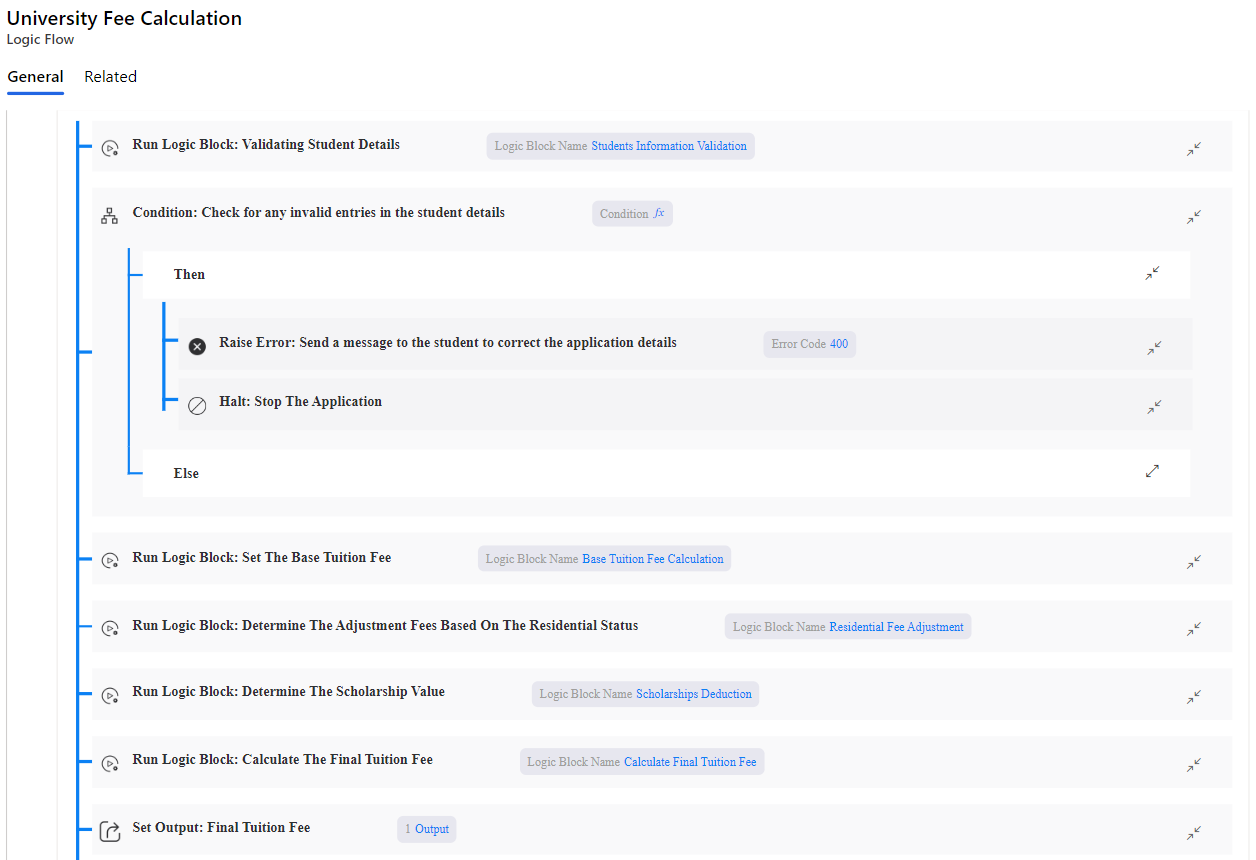
Following the flow in the picture above, and referencing the logic blocks we've created, here’s the step-by-step breakdown:
Gathering and Validating Student's Information: In this phase, the logic block designated for collecting student details is activated. From the student's full name to their scholarships, every piece of information undergoes rigorous validation. If there's a mismatch or missing detail, an error is immediately raised. This guarantees that the foundational data for our calculation is accurate and reliable.
Determining the Base Tuition Fee: Leveraging the decision table, the system reviews the student's chosen major and identifies the corresponding base tuition fee. The fee established here serves as the starting point for the final tuition fee calculation.
Accounting for Residential Status: The residential status of a student can greatly influence tuition fees. Using the designed decision table, the system adjusts the tuition based on whether the student is in-state, out-of-state, or international. If the residential data doesn't correspond to any of the predefined categories, an error is raised to flag the anomaly.
Factoring in Scholarships: Scholarships and financial aids are essential in the tuition calculation, often providing substantial relief to students. The logic block reviews the student's scholarships and applies the corresponding deductions. Any inconsistencies in this data will raise an error, ensuring only valid scholarships are considered.
Calculating the Final Tuition Fee: The penultimate step is the culmination of all previous phases. Here, the system triggers the logic block containing the formula that integrates base fees, residential adjustments, and scholarship deductions. The result is the definitive tuition fee amount the student is liable to pay.
Outputting the Result: The final logic block in our sequence takes the calculated tuition fee and processes it for presentation, providing a clear and concise fee statement for the student.
By weaving these logic blocks into a cohesive flow, we ensure a robust, transparent, and error-free mechanism for calculating university tuition fees.