Travel Expense Reimbursement Scenario
When employees travel for work, they often incur various expenses such as flights, accommodation, meals, and transportation. Reimbursing these expenses is a standard practice, but it involves a systematic approach to ensure fairness, accuracy, and adherence to company policy. This tutorial will guide you through a structured method to calculate the reimbursable amount for an employee's travel.
What We Will Do:
Collecting Travel Details
Capture essential details:
- Employee Name
- Departure (should be different from destination)
- Destination (should be different from departure)
- Duration of Stay (don't exeed the yealy vacation 15 days)
- Accommodation Type (Hotel, Hostel, Guest House)
Travel Expense Submission
- Data Gathering:
- Airfare: The cost of the flight ticket.
- Accommodation Costs: Daily rate for the stay.
- Meal Costs: Daily meal expenses.
- Miscellaneous Expenses: Other expenses like taxi fares, bus tickets, etc.
Expense Limit Verification
Each category has a set maximum limit based on company policy. Any amount exceeding this limit will not be reimbursed.
Verification Process
| Expense Category | Maximum Allowable (in $) |
|---|---|
| Airfare | 500.00 |
| Accommodation (Hotel) | 50.00/day --> 150.00/day |
| Meals | 50.00/day |
| Miscellaneous | 75.00/day |
Total Reimbursement Calculation
Calculation:
Total Reimbursement = Min(Airfare, 500) + Min(Accommodation Cost, Accommodation Limit * Duration) + Min(Meal Costs, 50 * Duration) + Min(Miscellaneous Expenses, 75 * Duration)
Communicating Reimbursement Outcome: Building the Flow
Once the reimbursable amount is determined, communicate the amount to the employee. This ensures transparency, and the employee understands how the reimbursement was calculated.
Solution
Step 1: Creating a Validation Set to validate the employee travel details.
To initiate our solution, we will be designing a Validation Set. That accept the employee travel informations as input.
- Employee Name
- Departure
- Destination
- Duration of Stay
- Accommodation Type
Each of these inputs is equipped with its own validation block to ensure accuracy and correct format, as shown in the picture below.
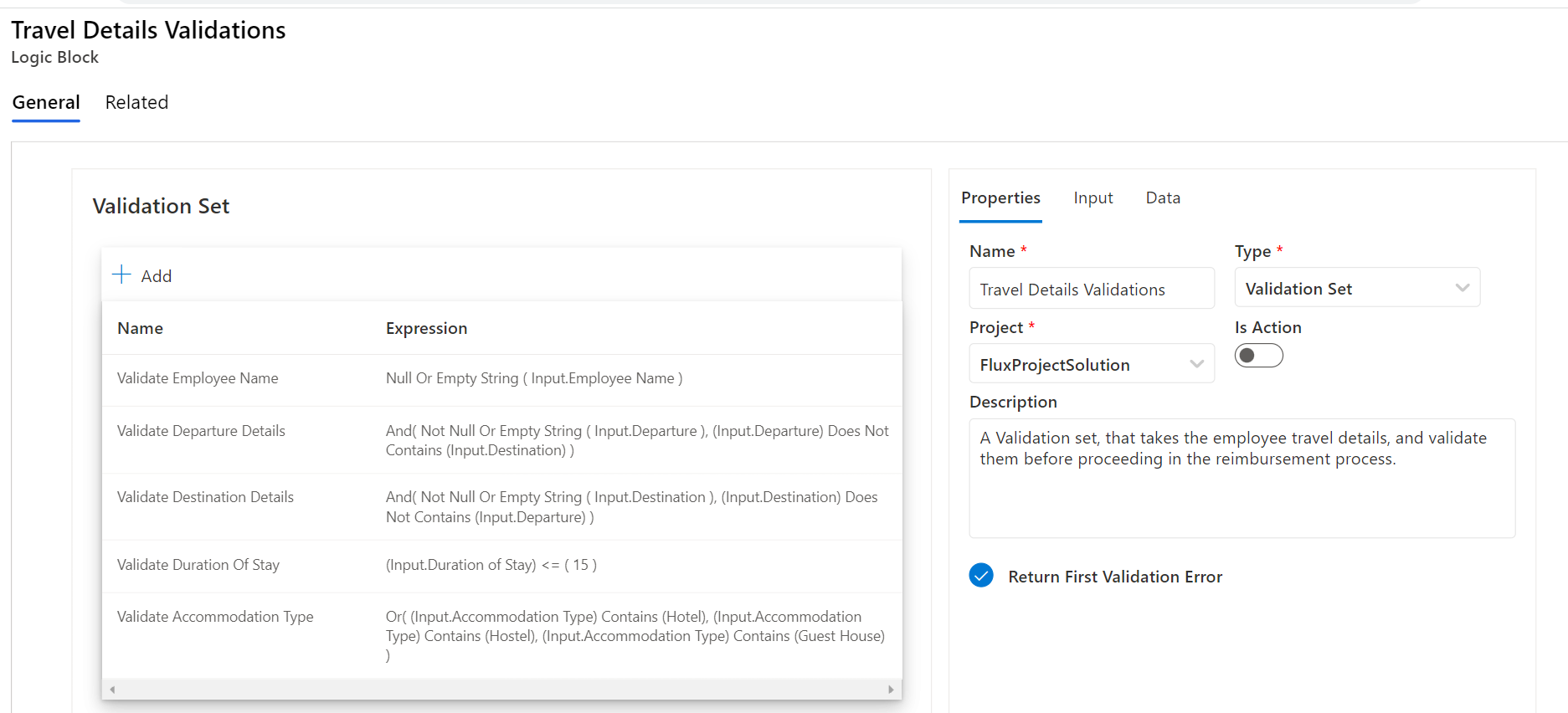
And the validation set return an error upon encountering the first inconsistency or inaccuracy. This is to ensure immediate feedback for rectification. With our Validation Set in place, it guarantees that all subsequent steps in the evaluation rely on verified and dependable data.
Step 2: Constructing a Validation Set for Travel Expense Limits
In Step 2, we're focusing on constructing a validation mechanism to oversee travel-related expenses, ensuring they remain within permissible limits, so the employee can get a reimbursement.
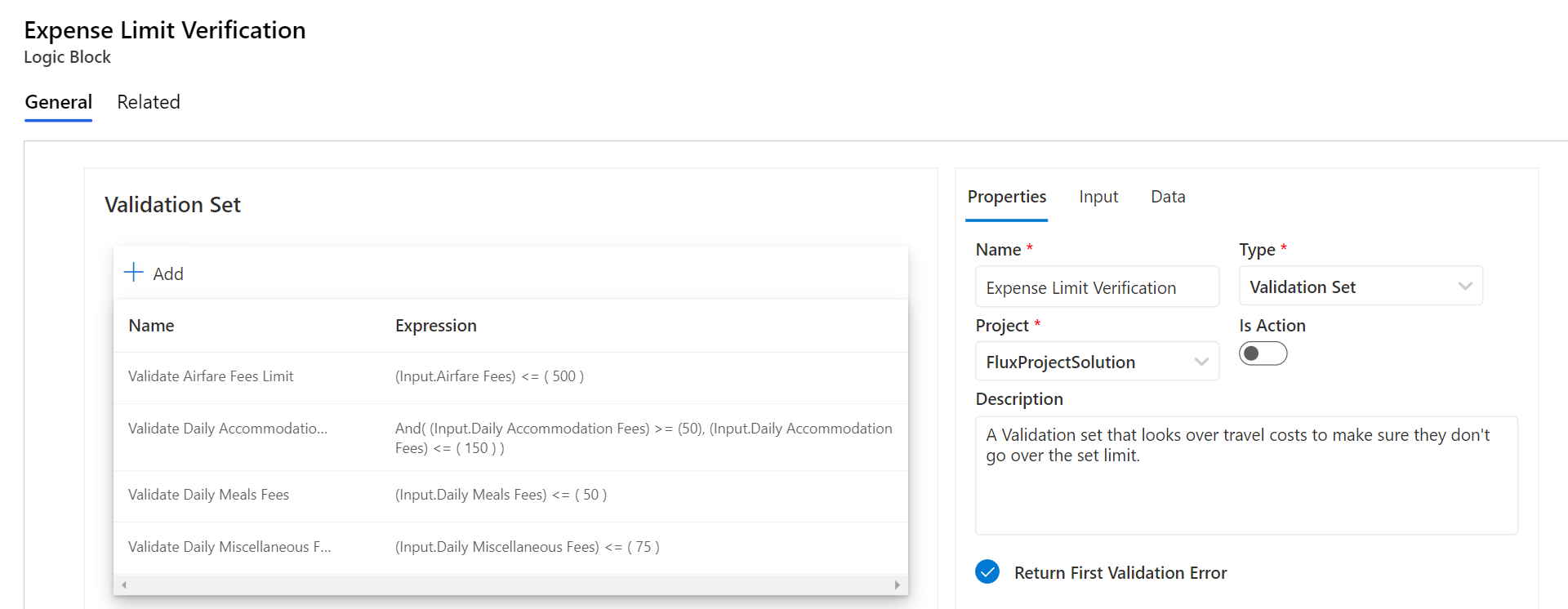
As we can see in the validation set above, the airfare is being validated to ensure it's less than or equal to $500. For accommodation, the costs should fall within a range, from a minimum of $50 per day to a maximum of $150 per day. Meals have a set threshold, with costs required to be $50 per day or lower. And lastly, any miscellaneous expenses should be kept under $75 per day. The validation set returns an error upon encountering the first inconsistency or inaccuracy. This is to ensure immediate feedback for rectification. With our Validation Set in place, it guarantees that all subsequent steps in the evaluation rely on verified and dependable data.
Step 3: Creating a Formula to Calculate the Total Reimbursement
For our third step, we delve into the mathematical core of our process. After validating the travel expenses and details, it's vital to accurately compute the total reimbursement amount for each claim. To achieve this, we have designed a formula that accounts for both the specific expense and its respective limit over the duration of the trip.
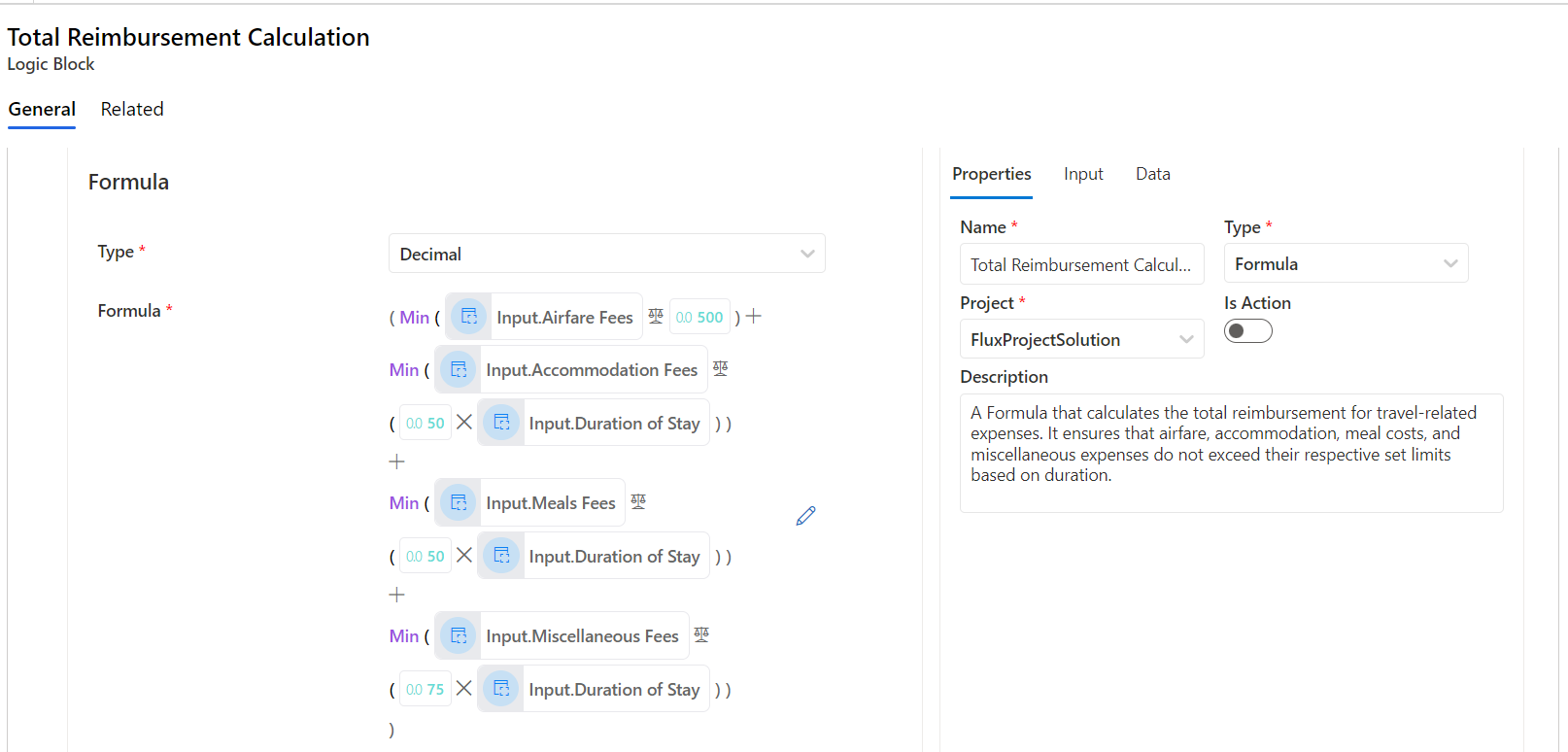
The formula provided is meticulously designed to ensure both accuracy and fairness in calculating reimbursements:
Airfare: The reimbursement for airfare ensures that it doesn't exceed $500. If the actual airfare is less than this, that amount will be considered; otherwise, the capped amount of $500 will be the reimbursed amount.
Accommodation: The accommodation reimbursement is a bit more dynamic. It considers the cost of accommodation per day and compares it to the allowable limit multiplied by the duration of the stay. This ensures that longer stays don't inadvertently lead to inflated reimbursement claims.
Meals: Every day's meal costs are validated against a $50 threshold. If an employee's daily meal costs exceed this, they will be reimbursed up to the limit, ensuring consistency across all reimbursements.
Miscellaneous Expenses: These are capped at $75 per day. Like meals, if an employee claims more than this per day, the reimbursement will be limited to the $75 threshold.
By following this formula, the organization ensures that reimbursements are consistent, fair, and within budgetary constraints, all while adhering to the policies set forth.
Step 4: Connecting the Dots - Creating The Travel Expenses Reimbursement Flow
Flows logic function as structured sequences, emphasizing the systematic orchestration of tasks in a designated order. Central to this flow are its individual logic blocks, which when executed in the specific order, not only facilitate the flow but also ensure its efficacy. For our employee travel expenses reimbursement, every logic block has been meticulously crafted to address its intended function, ensuring data integrity and the strict adherence to reimbursement guidelines. Whenever a validation logic block detects inconsistencies or inaccuracies, an error is raised, prompting an immediate resolution.
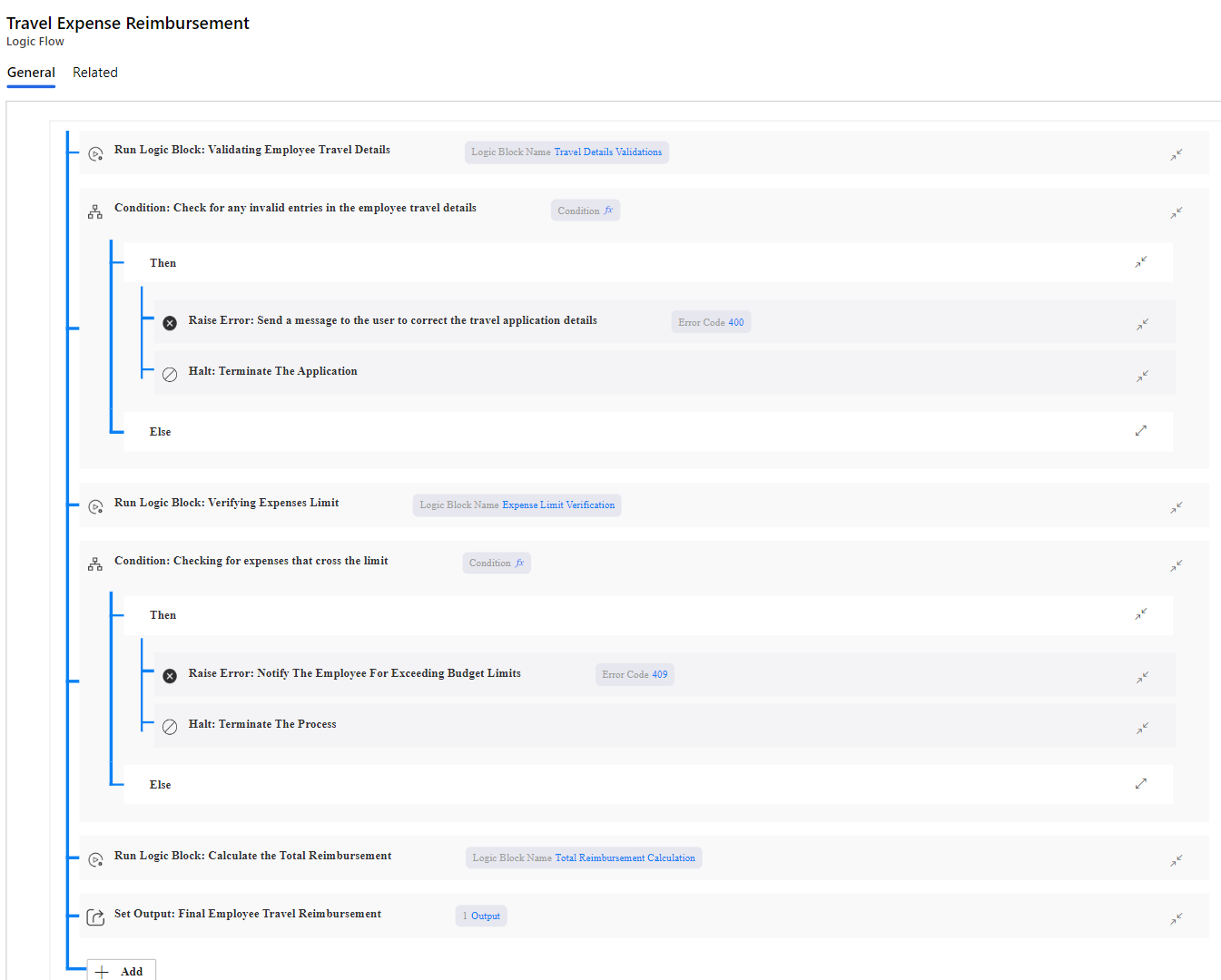
Following the flow in the picture above, and referencing the logic blocks we've created, here’s the step-by-step breakdown:
Gathering Information: This initial logic block gathers all necessary data related to the employee's travel details. Essential details such as Employee Name, Departure, Destination, Duration of Stay, and Accommodation Type are collected here.
Validating Details: The logic block titled 'Validation Set' kicks into action here. Every piece of information provided undergoes scrutiny to ensure accuracy and the adherence to the required format. Should any discrepancies emerge, an error is raised, thereby safeguarding the integrity of the data.
Validating Expenses Limit: Before diving into the calculation of the total reimbursement, our dedicated logic block checks that each expense aligns with the organizational thresholds. If any expense surpasses its corresponding permissible limit, an error is raised, ensuring that only legitimate claims proceed further.
Calculating Total Reimbursement: This phase involves the logic block that houses our comprehensive formula to ascertain the exact reimbursement amount for each claim. By considering each specific expense and its respective limit, this block guarantees accuracy, consistency, and fairness in every reimbursement calculation.
Output: At the culmination of our flow, the final logic block generates the computed reimbursement amount. This amount, deduced after rigorous validation and calculation logic blocks, signifies the exact value to be reimbursed to the employee.
By adhering to this structured flow and executing the specified logic blocks in sequence, we champion a seamless, transparent, and efficient process for evaluating and determining travel expenses reimbursements for all employees.